
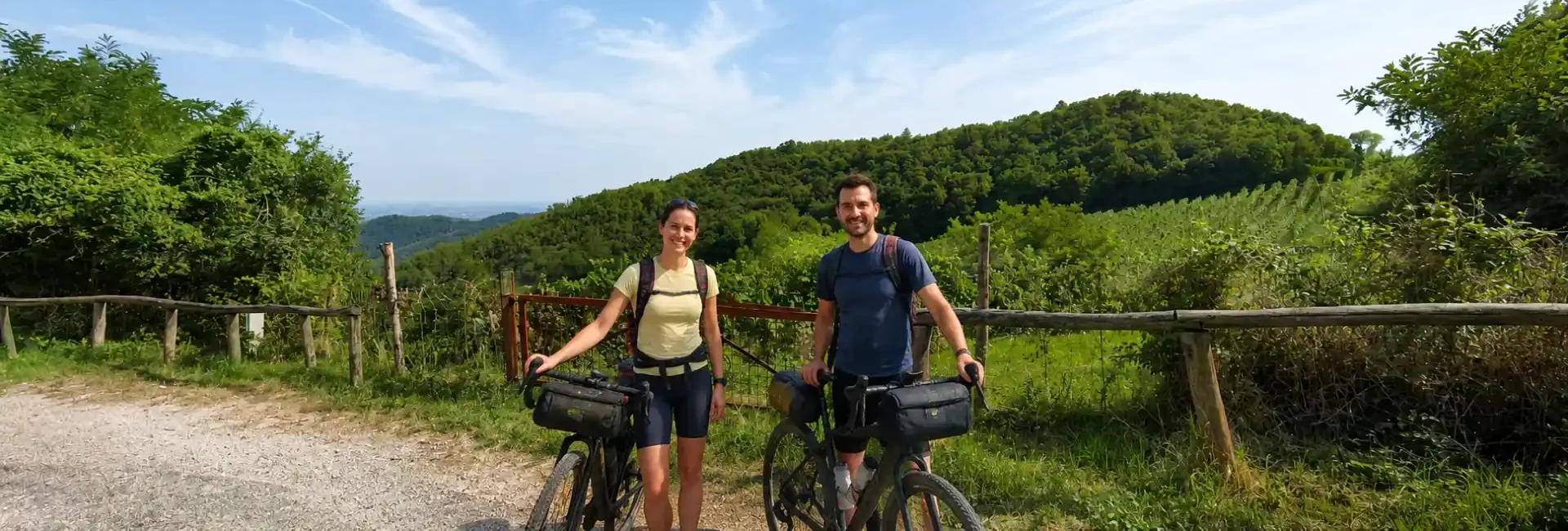
Euganei by Bike: Cycling Through Villages, Spa Towns and Volcanic Landscapes
The Euganei are one of the most rewarding destinations for travellers who want to cycle from Padua through flat countryside, medieval towns, Venetian villas, abbeys and volcanic landscapes. From Hotel Giotto, cyclists can reach the Canale Battaglia route and continue towards Abano Terme, Montegrotto Terme and the E2 Cycle Ring, which is approximately 63 kilometres long. Those who prefer a shorter ride can combine cycling with a regional train from Terme Euganee, Monselice or Este.
Why explore the Euganei by bike
The hills rise unexpectedly from the plain, forming a distinctive landscape of isolated volcanic peaks and conical slopes. Cycling around the Euganei means passing canals, vineyards, olive groves, spa towns, castles and historic villages built along the lower slopes.
The variety of the landscape makes it possible to plan very different cycling days. The E2 Cycle Ring is mostly flat and suitable for touring, while the roads climbing towards Teolo, Arquà Petrarca, Castelnuovo and the higher villages require better fitness and careful management of the gradients.
Before setting out, it is important to distinguish the lowland cycle ring from the trails inside the Regional Park. Not every woodland road or hiking trail is open to bicycles, and some sections may only be used along authorised routes. Cyclists should always check current maps, notices and access restrictions before entering the park.
The E2 Cycle Ring around the Euganei
The Euganei Cycle Ring, identified as route E2, is approximately 63 kilometres long. It runs mainly around the foot of the hills and follows paved cycle paths, quiet secondary roads, riverbanks and a few short unpaved sections. Near the historic towns, some stretches continue on ordinary roads.
The official route can be joined from several locations. Montegrotto Terme, Battaglia Terme, Monselice, Este, Lozzo Atestino, Vo’ and Teolo are all useful starting points for dividing the ring into stages or choosing a shorter section for a day trip.
Completing the full route normally takes several hours. Additional time should be allowed for breaks, cultural visits, detours and the connection from Padua. The total duration depends on cycling speed, wind, road surface, temperature and the number of planned stops.
Cycling from Padua to the Canale Battaglia
To reach the Euganei from Hotel Giotto, cyclists can ride towards Prato della Valle and continue in the direction of Bassanello. From there, the Canale Battaglia route provides a practical way to leave the city while avoiding some of the busiest roads.
After approximately 5 kilometres from the Bassanello area, the route passes Villa Molin, designed by Vincenzo Scamozzi at the end of the sixteenth century. Continuing along the canal leads to Battaglia Terme, where cyclists can visit the Catajo Castle and the Museum of River Navigation.
The connection from Padua significantly increases the total distance. Anyone planning to complete the full E2 route in one day must also include the outward and return journey between the city and the chosen access point. For many touring cyclists, using the train for one leg of the journey is a more practical option.
Villa Molin and the historic waterway
The Canale Battaglia accompanies the first section of the journey towards the Euganei. For centuries, this waterway connected Padua with the southern part of the province and was used to transport agricultural products, goods and trachyte extracted from the hills.
Villa Molin stands close to the point where the Bacchiglione River meets the canal. Its location reflects the importance of waterways for the movement of Venetian noble families and for the economy of the villas built throughout the countryside.
Access to the interiors depends on scheduled openings and events. Even when the villa is closed, its architecture remains an easily recognisable landmark along the cycling route.
Battaglia Terme and the Catajo Castle
Battaglia Terme is one of the most interesting gateways to the eastern side of the Euganei. The town developed around canals and navigation locks that still reflect its historical connection with river transport.
The Catajo Castle overlooks the road between Battaglia Terme and Monselice. Built from the sixteenth century onwards by the Obizzi family, it combines the characteristics of a residence, a fortress and a ceremonial palace. The climb to the entrance and the visit to the interiors require time, so they should be included carefully in the day’s cycling schedule.
Nearby, the Museum of River Navigation explores the lives of boatmen, traditional cargo vessels and the commercial activities that once animated the local canals. Opening times should be checked before departure.
Monselice, the Rocca and the Sanctuary of the Seven Churches
On the southern side of the Euganei, the cycle ring passes through Monselice, a medieval town dominated by the Rocca hill. The lower part of the town is easy to reach by bicycle, while the ascent towards the Sanctuary of the Seven Churches includes steep gradients and uneven surfaces that may make it more comfortable to continue on foot.
The devotional route leads to Villa Duodo and includes six chapels dedicated to the major basilicas of Rome, followed by the Church of San Giorgio. The complex houses religious relics and offers wide views across the surrounding plain.
Monselice railway station is useful for ending the ride early or organising a one-way route. Before travelling, cyclists should check that the selected regional train accepts fully assembled bicycles.
Este and the western side of the Euganei
Este is one of the main cultural stops along the Euganei route. The town preserves the Carraresi Castle and its large public gardens, as well as the National Atestino Museum, which documents the ancient Veneti civilisation and the archaeological history of the area.
Este can be used as a starting point, finishing point or extended rest stop. Its railway station makes it possible to shorten the route, although bicycle transport depends on the service available on the chosen train.
Along the western section, the landscape becomes increasingly rural. Fields, drainage channels, rows of trees and the profiles of the hills accompany cyclists towards Lozzo Atestino and Vo’, with long stretches exposed to both sun and wind.
Lozzo Atestino, Vo’ Vecchio and the vineyards
The north-western section of the Euganei crosses an agricultural area known for its vineyards and local produce. Vo’ Vecchio preserves the layout of an old Venetian administrative centre and offers an interesting detour for cyclists who want to discover a quieter and less tourist-oriented side of the hills.
This area is also known for Fior d’Arancio Colli Euganei DOCG, a wine made from Moscato Giallo grapes. Any tasting should be planned responsibly, as cyclists must remain fully capable of controlling their bicycle and complying with road safety rules.
During summer, the open sections of the route can become very hot. Cyclists should carry enough water and check possible refill points in advance rather than relying only on fountains or seasonal businesses.
Praglia Abbey and the northern side
The northern side of the Euganei offers the opportunity to visit Praglia Abbey, a Benedictine monastery founded during the Middle Ages and largely rebuilt between the fifteenth and sixteenth centuries. The abbey is also known for its workshop dedicated to the restoration of ancient books.
Reaching the monastery requires leaving the main cycle ring and following local roads. Guided tours, religious services and access to the monastic buildings follow specific schedules, which should be checked before departure.
From Praglia, cyclists can continue towards Teolo or return through Abano Terme and Montegrotto Terme. Routes through the interior of the hills involve steeper climbs than the E2 and may include roads open to traffic.
Arquà Petrarca as a hill route
Arquà Petrarca is one of the best-known destinations in the Euganei, although it is not located directly on the flat cycle ring. Reaching the village requires a detour with more demanding gradients.
The historic centre preserves the house where Francesco Petrarch spent the final years of his life and the poet’s tomb, located in front of the Church of Santa Maria Assunta. Its narrow, cobbled streets make it advisable to leave the bicycle in an authorised area and continue on foot.
Road bike, gravel bike or mountain bike
Trekking bikes, gravel bikes, well-equipped city bikes and e-bikes are suitable for the main cycle ring. A road bike can cover most of the route, although extra care is required on short unpaved or uneven sections.
A mountain bike is more suitable for authorised routes inside the Regional Park. The designated mountain-bike trail consists mainly of paths and unpaved roads and includes some narrow or steep sections.
Cyclists should not assume that every hiking trail is open to bicycles. Before entering the park, it is essential to check the permitted use of each route, current regulations and any temporary restrictions.
When to cycle through the Euganei
Spring and autumn are generally the most pleasant seasons for cycling in the Euganei. Temperatures are usually milder, while the agricultural landscape changes with spring blossoms, the grape harvest and the colours of the woodland.
During summer, it is advisable to start early, use adequate sun protection and remember that several sections of the route offer little shade. In winter, shorter daylight hours require efficient bicycle lights and careful planning.
After heavy rain, cyclists may encounter mud, debris, minor landslides or temporary closures. Before using trails or internal detours, check current conditions and never pass barriers or ignore official restrictions.
Organising the return journey by train
Travelling by train makes it possible to explore the hills without completing both the entire cycle ring and the connection with Padua. The most useful railway stations are Terme Euganee-Abano-Montegrotto, Monselice and Este.
Fully assembled bicycles can be carried on authorised regional trains, subject to available space and the required bicycle ticket. The bicycle must not exceed two metres in length, and every train included in the selected journey must permit bicycle transport.
Closed folding bicycles can usually be carried free of charge on regional trains when they comply with the permitted dimensions. Before travelling, check timetables, changes, station accessibility and the bicycle symbol shown for each service.
Travelling from Hotel Giotto
From Hotel Giotto, cyclists can reach Prato della Valle through a short urban section before continuing towards Bassanello and the Canale Battaglia. An updated cycling map or GPS route is recommended to avoid the busiest roads.
Guests who prefer to begin closer to the Euganei can cycle to Padua railway station and take an authorised regional train to Terme Euganee, Monselice or Este. On the urban route between the hotel and the station, particular attention should be paid to tram tracks and pedestrian areas.
Further practical information is available on the How to reach Hotel Giotto page.
Guests arriving by car with a bicycle rack can request the hotel’s private paid parking, subject to availability. The vehicle’s height and length should be communicated in advance whenever the rack changes its standard dimensions.
Recommended preparation and equipment
- Two water bottles or enough water for the season and distance.
- A spare inner tube or a repair kit for tubeless tyres.
- A pump, tyre levers, multitool and quick link.
- Front and rear lights, even when planning to return during daylight.
- A GPX route available offline.
- A windproof or waterproof jacket.
- A bicycle lock for stops in villages and towns.
- A power bank for a smartphone or navigation device.
Before departure, check tyre pressure, brakes, transmission and e-bike battery range. A mostly flat ride of 63 kilometres can become considerably longer when the connection from Padua, cultural detours and climbs to the hill villages are included.
Staying at Hotel Giotto
Hotel Giotto has a dedicated area for bicycle storage. The number and type of bicycles should be communicated before arrival, especially for e-bikes, tandems, cargo bikes or larger groups.
Rooms include a private bathroom, air conditioning, Wi-Fi, television and minibar. Breakfast offers both sweet and savoury choices, making it suitable before a long day of cycling.
Guests staying for several nights can alternate the cycle ring with a day in Padua or a hill route towards Arquà Petrarca, adapting each ride to their experience, fitness and available time.
Book your stay and explore the Euganei by bike
From Hotel Giotto, you can organise one or more cycling days through the Euganei, choosing between the mostly flat E2 ring, medieval towns and more demanding hill routes. Before booking, communicate the number of bicycles and request confirmation that suitable storage space is available.
Frequently asked questions
How long is the Colli Euganei Cycle Ring?
The E2 Cycle Ring is approximately 63 kilometres long. When starting from Padua, cyclists must also include the distance required to reach the route and return to the city.
Is the cycle ring suitable for less experienced cyclists?
The main route is mostly flat, but its length requires stamina and careful time management. Cyclists can complete only part of the ring and return by train.
Which type of bicycle is recommended?
Trekking bikes, gravel bikes and e-bikes are particularly versatile. Road bikes require care on short unpaved sections, while mountain bikes are suitable for authorised park routes.
How can I reach the cycle ring from Hotel Giotto?
From the hotel, cycle towards Prato della Valle, Bassanello and the Canale Battaglia. Alternatively, take an authorised regional train to Terme Euganee, Monselice or Este.
Can I take my bicycle on the train?
Yes, fully assembled bicycles are permitted on authorised regional trains, subject to available space and the required ticket. Check that every train included in the journey accepts bicycles.
Does Hotel Giotto provide bicycle storage?
Yes, the hotel has a dedicated bicycle storage area. Guests should request confirmation before arrival and specify the number and type of bicycles.
You may also be interested in: Hotel with Bike Storage Near the City Centre, Hotel with Secure Bicycle Storage, Bike Security in Padua: Where to Leave Your Bicycle During Your Stay, Cycling Routes from Padua: Rivers, Historic Villages and the Euganean Hills, Arquà by Bike from Padua, Ostiglia Cycle Route from Padua and Weekend by Bike in Padua: A Two or Three-Day Cycling Itinerary.