
Franciscans in Padua: Places, Art and the Legacy of Saint Anthony
The Franciscans of Padua are part of a story that extends far beyond a visit to Saint Anthony’s Basilica. Around the Saint’s Tomb are cloisters, museums, confraternities, frescoed chapels and convent spaces that have preserved centuries of Franciscan life. Further north, the Sanctuary of Arcella commemorates Saint Anthony’s final hours. Staying at Hotel Giotto allows visitors to reach many of these places on foot, while public transport makes it easy to continue towards the more distant sites.
The heart of the Franciscans in Padua
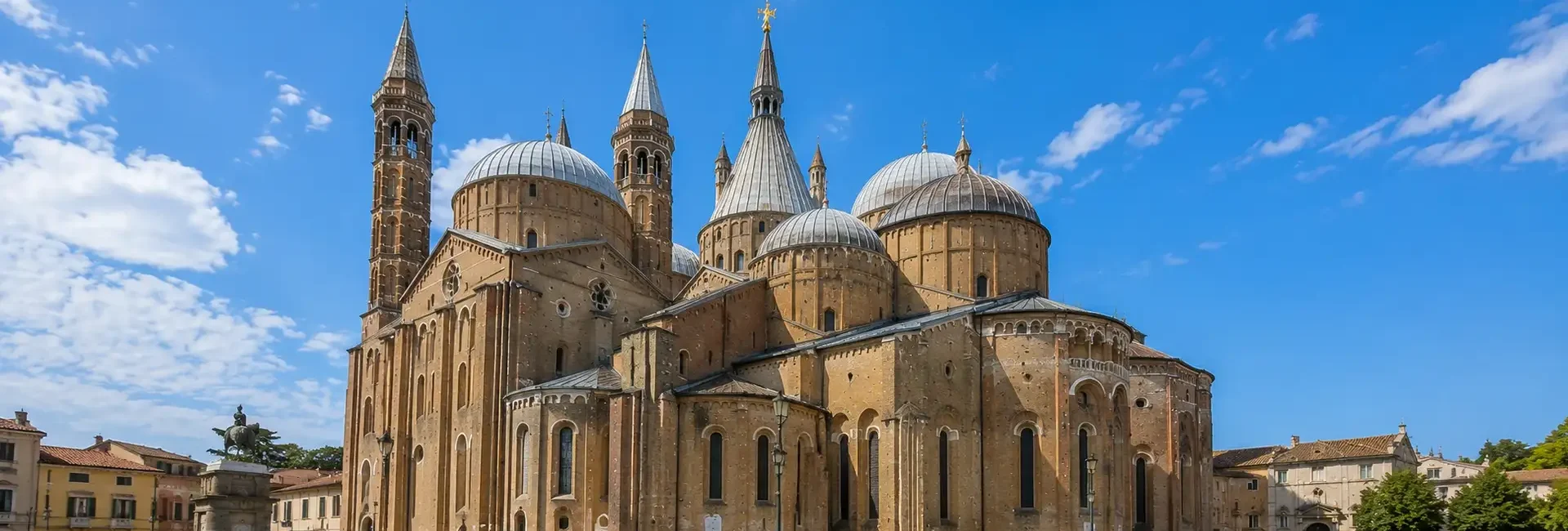
The centre of the Franciscans in Padua is Saint Anthony’s Basilica, known locally simply as “Il Santo”. More than an impressive church, it is the heart of a religious complex entrusted to the Franciscan Friars Conventual. Prayer, hospitality for pilgrims, artistic heritage, study and pastoral activities continue to coexist within the same historic setting.
The visit naturally begins at the Chapel of the Ark, where Saint Anthony’s Tomb is located. Touching the marble tomb has become a meaningful gesture shared by pilgrims from around the world. Nearby is the Chapel of the Relics, also known as the Treasury Chapel, which preserves important relics connected with Saint Anthony’s life and preaching.
Visitors wishing to understand the presence of the Franciscans in Padua should also spend time in the quieter parts of the complex. Walking from the Basilica into the cloisters reveals the daily life of a religious community that continues to welcome visitors, celebrate the liturgy and preserve the Antonian tradition.
The five cloisters of the Franciscans
The Franciscan convent is organised around five cloisters: Paradise, Novitiate, Magnolia, General and Museum, also known as Blessed Luca Belludi Cloister. Not all of them are permanently open to visitors, as some remain part of the private convent while others can only be accessed during guided tours or special events.
The Magnolia Cloister takes its name from the large tree standing at its centre and is one of the most recognisable areas within the complex. The Blessed Luca Belludi Cloister provides access to the museum spaces, while the Novitiate Cloister preserves its historic connection with the formation of young Franciscans and is generally accessible only during organised visits.
One of the lesser-known highlights is the Chapter House, included in selected guided itineraries. Visitors may also discover the historic water system beneath the Novitiate Cloister and enjoy unique views of the Basilica’s domes. Access to these normally closed areas depends on the official programme of special openings.
The Scuola del Santo and the Franciscans’ confraternity
Beside the church square stands the Scuola del Santo, commonly called the Scoletta. It was originally built as the headquarters of the Confraternity of Saint Anthony, with the ground floor dating from around 1430 and the upper floor completed during the early sixteenth century.
The upper hall preserves an extraordinary cycle of paintings illustrating the life and miracles of Saint Anthony. Among the artists involved was the young Titian, who painted three famous Antonian scenes. These works demonstrate how charity, preaching and miracles were communicated visually to confraternity members, citizens and pilgrims alike.
The Archconfraternity reminds visitors that the history of the Franciscans in Padua has never belonged solely to religious communities. For centuries, lay people have contributed through prayer, charitable work and the promotion of devotion to Saint Anthony.
The Oratory of Saint George and Altichiero’s frescoes
Only a short walk from the Scoletta stands the Oratory of Saint George, a fourteenth-century funerary chapel commissioned by the Lupi di Soragna family. Almost every wall is covered with frescoes painted by Altichiero da Zevio between 1379 and 1384, with the collaboration of Jacopo da Verona.
The scenes dedicated to Saint George, Saint Catherine and Saint Lucy transform the chapel into an immersive artistic experience. Today the Oratory forms part of Padua Urbs Picta, the UNESCO World Heritage Site dedicated to Padua’s fourteenth-century fresco cycles. Visiting it allows travellers to combine Antonian spirituality with medieval art without moving far from the Basilica.
The intimate dimensions of the chapel and the richness of its decoration encourage a slower visit. Opening days and admission arrangements may change during religious celebrations or cultural events, so planning ahead is always advisable.
The Antonian Museum and Franciscan devotion
The Antonian Museum preserves paintings, sculptures, liturgical vestments, tapestries, goldsmith works and architectural models created over the centuries for Saint Anthony’s Basilica and the Veneranda Arca. Founded in the late nineteenth century, it closed during the Second World War before reopening in 1995 to celebrate the eighth centenary of Saint Anthony’s birth.
One of its most distinctive sections is the Museum of Popular Devotion, where ex-votos and objects donated from around the world illustrate the global spread of devotion to Saint Anthony. Among its most unusual treasures is a silk version of the “Si quaeris miracula” prayer written in Chinese.
These collections show how the spirituality of the Franciscans has inspired expressions of faith across different cultures and continents. Rather than being simple museum exhibits, many objects represent personal stories of gratitude, hope and devotion passed on through generations.
The Sanctuary of Arcella: where Saint Anthony died
The second major destination in this itinerary lies north of Padua railway station. The Sanctuary of Arcella, also known locally as Sant’Antonino, stands on the site traditionally associated with Saint Anthony’s death on 13 June 1231 while travelling from Camposampiero to Padua.
Inside the sanctuary visitors can see the room that commemorates Saint Anthony’s final moments. The church also preserves the relics of Blessed Elena Enselmini. Compared with the Basilica, the atmosphere here is quieter and more intimate, offering a deeper understanding of the final chapter of Saint Anthony’s life.
The connection between Saint Anthony’s Basilica and Arcella becomes especially meaningful every year on 12 June during the celebration of the Transitus, which commemorates the Saint’s final journey. Throughout the rest of the year, both Franciscans sites can comfortably be visited on the same day using the city’s tram network.
Extending the journey to Camposampiero
Travellers with additional time may wish to continue towards Camposampiero, approximately thirty kilometres from Padua. Here two important sanctuaries — the Sanctuary of the Vision and the Sanctuary of the Walnut Tree — preserve memories of Saint Anthony’s final period before his death.
According to tradition, the Sanctuary of the Vision marks the place where Saint Anthony experienced the vision of the Child Jesus, while the Walnut Tree Sanctuary recalls the place where he prayed among the branches of a great walnut tree. Together these destinations complete the story that begins with the Franciscans heritage preserved in Padua.
Camposampiero can be reached by car or by train from Padua. Before travelling, visitors should always verify opening hours and visiting arrangements for the sanctuaries.
Reaching the Franciscans sites from Hotel Giotto
Hotel Giotto enjoys an excellent location for exploring the city’s main Franciscans landmarks. Saint Anthony’s Basilica is only a short walk away, while the Scuola del Santo, the Oratory of Saint George, the Antonian Museum and the accessible cloisters are all located within the same area.
Walking from the hotel
The Antonian complex can easily be explored on foot. From Piazzale Pontecorvo, visitors simply follow Via del Santo towards Piazza del Santo, where the Basilica and the surrounding monuments are located.
Reaching Arcella by tram
To visit the Sanctuary of Arcella, guests can walk to the “Santo” tram stop near the Basilica and continue north. From the Arcella stop, the sanctuary is reached with a short walk.
Arriving from Padua railway station
Travellers arriving by train can reach the Basilica area using the tram and get off at the “Santo” stop. From there, the main Franciscans monuments are all within easy walking distance.
Travelling by car
Guests travelling by car may request Hotel Giotto’s private parking, available for an additional charge and subject to availability. From the hotel, the Antonian complex is best explored on foot, while Arcella and Camposampiero can easily be reached afterwards by car if desired.
Before your visit, you can also consult our guide explaining how to reach Hotel Giotto.
A one-day Franciscan itinerary
Begin the morning at Saint Anthony’s Basilica, visiting the Tomb, the Chapel of the Relics and the accessible cloisters. Continue with the Scuola del Santo, the Oratory of Saint George and the Antonian Museum before taking a break for lunch.
In the afternoon, continue to the Sanctuary of Arcella. Visitors preferring a slower pace may divide the itinerary into two separate days, adding Camposampiero as an optional extension.
Stay close to the Franciscans heritage
Hotel Giotto provides an excellent base for discovering the city’s Franciscans heritage without unnecessary travel. Its location close to Saint Anthony’s Basilica allows guests to attend morning celebrations, return to the hotel during the day and revisit the Sanctuary in the evening.
The hotel offers air-conditioned rooms, Wi-Fi, private bathrooms, minibar and a generous breakfast. Private parking is also available upon request, subject to availability, making it convenient for visitors arriving by car.
Book directly on the official website
If you wish to explore the history of the Franciscans in Padua while staying just a short walk from Saint Anthony’s Basilica, book directly through the official Hotel Giotto website. Enjoy a comfortable stay in the historic centre while discovering the city’s remarkable artistic, religious and cultural heritage.
Frequently Asked Questions
Which are the main Franciscan sites in Padua?
The main sites include Saint Anthony’s Basilica, the convent cloisters, the Scuola del Santo, the Oratory of Saint George, the Antonian Museum and the Sanctuary of Arcella.
How far is Saint Anthony’s Basilica from Hotel Giotto?
The Basilica is only a short walk from Hotel Giotto, making it easy to explore the Antonian complex on foot.
How can I reach the Sanctuary of Arcella from Hotel Giotto?
Walk to the Santo tram stop near the Basilica, take the tram north and continue with a short walk from the Arcella stop.
Are all the convent cloisters open to visitors?
No. Some cloisters can only be visited during guided tours or special openings because they remain part of the active convent.
To learn more, visit: Hotel Near the Basilica, Where to Stay to Visit the Basilica, Pilgrimage to Padua: Hotel Near Saint Anthony’s Basilica, Padua for Pilgrims, Religious Itinerary in Padua: What to See Near Saint Anthony, Saint Anthony: The 13 June Festival in Padua, Religious Groups in Padua.