
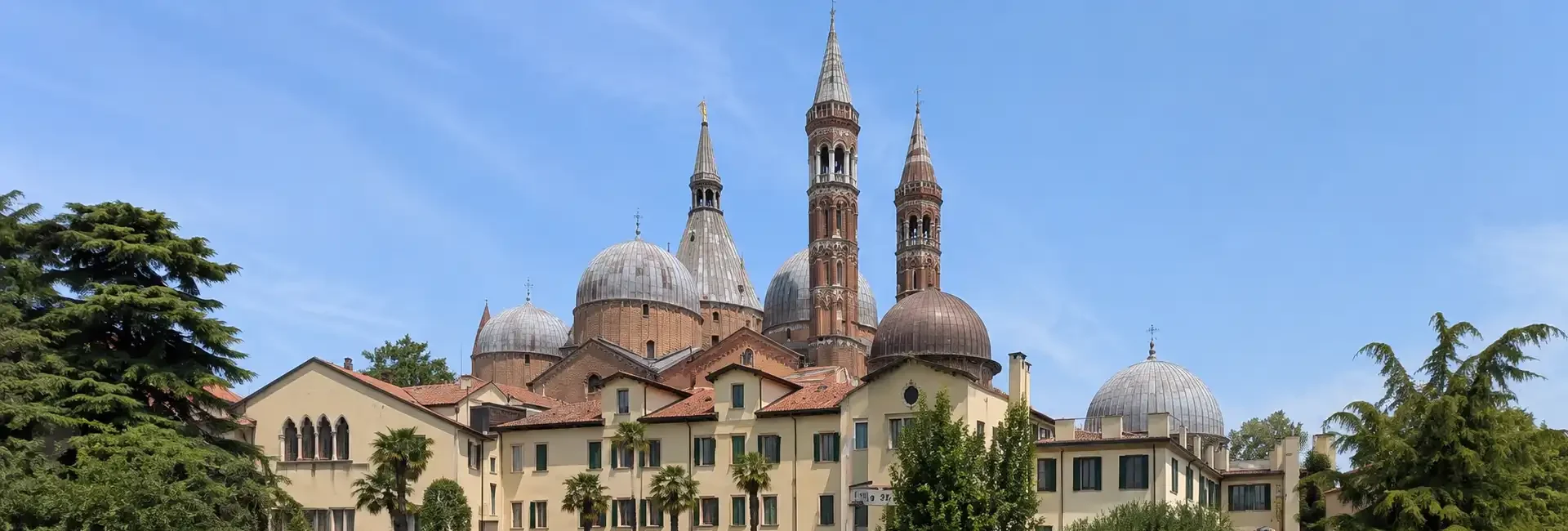
Religious Itinerary in Padua: What to See Near Saint Anthony
A religious itinerary in Padua can begin at Hotel Giotto, located in Piazzale Pontecorvo 33, and continue on foot to some of the city’s most important places of worship. This route connects Saint Anthony’s Basilica, Prato della Valle, the Basilica of Saint Giustina, the Cathedral Baptistery and, with a short journey by tram or bus, the Sanctuary of Arcella, where Saint Anthony spent the final moments of his life.
Padua is a city where faith, art and history come together within walking distance. Its historic centre preserves monumental churches, Franciscan landmarks, medieval frescoes and centuries of Christian heritage. Staying close to Saint Anthony’s Basilica allows visitors to enjoy a well-organised route, with comfortable walking distances, time to return to the hotel and a more relaxed experience for sightseeing, prayer and religious celebrations.
A walking religious itinerary from Hotel Giotto
Hotel Giotto is an excellent starting point for a religious itinerary because Saint Anthony’s Basilica is only a short walk away. Guests can avoid driving, searching for parking or dealing with the city’s restricted traffic zones. The route is suitable for pilgrims, couples, families, parish groups and anyone wishing to discover Padua through its spiritual heritage.
A recommended route begins at Saint Anthony’s Basilica, continues to the Oratory of Saint George and the Scuola del Santo, then reaches Prato della Valle and the Basilica of Saint Giustina before continuing towards the Cathedral Baptistery and the historic centre. This religious itinerary can easily be adapted to the length of your stay: half a day for the main highlights, a full day for a more leisurely visit, or two days if you also wish to include the Sanctuary of Arcella and additional Franciscan sites.
If your main interest is Saint Anthony’s Basilica, you may also find useful our pages about hotel near Saint Anthony’s Basilica and where to stay to visit Saint Anthony’s Basilica. Pilgrims and organised religious groups may also be interested in our guides about pilgrimage in Padua and hotel for pilgrims in Padua.
First stop: Saint Anthony’s Basilica
Saint Anthony’s Basilica is the spiritual heart of Padua. According to the official Basilica website, the church opens at 6:15 am and celebrates Mass several times throughout the day, while the Penitentiary offers dedicated confession times. Beginning your religious itinerary early in the morning allows you to experience the Basilica in a quieter and more contemplative atmosphere, particularly on weekdays.
The Tomb of Saint Anthony is the most meaningful part of the visit. Thousands of pilgrims pause here in silent prayer, touching the marble tomb and leaving their intentions. Afterwards, visitors should take time to discover the Treasury Chapel, the peaceful cloisters, the Antonian Museum and the Franciscan spaces surrounding the Basilica. Just outside are two remarkable artistic landmarks: the Oratory of Saint George and the Scuola del Santo.
For many visitors, the Basilica naturally occupies the first part of the morning. Guests staying at Hotel Giotto can comfortably walk there, attend Mass or another religious celebration, explore the main areas of the complex and return to the hotel before continuing towards Prato della Valle or Saint Giustina.
Second stop: Prato della Valle and Saint Giustina
From Piazza del Santo, continue your religious itinerary towards Prato della Valle, one of the largest and most recognisable squares in Europe. The short walking distance makes this section pleasant and accessible, while the open square offers a perfect place to relax before entering the impressive Basilica of Saint Giustina.
Saint Giustina is one of Padua’s most important Christian monuments. According to the Abbey, the area was already a Christian burial ground during Roman times, and it was here that the young martyr Justina was laid to rest on 7 October 304. Today the Basilica houses the tombs of Saint Justina, Saint Prosdocimus—the first Bishop of Padua—and the relics traditionally attributed to Saint Luke the Evangelist.
For travellers interested in both history and spirituality, this is an essential part of the religious itinerary. The Chapel of Saint Prosdocimus, the Corridor of the Martyrs, the magnificent nave and the main altar tell the story of Christian Padua long before the city’s medieval development around Saint Anthony. Before visiting, it is advisable to check opening hours and Mass schedules on the Abbey’s official website.
Third stop: The Cathedral Baptistery
From Saint Anthony’s Basilica and Saint Giustina, continue towards Padua Cathedral and its remarkable Baptistery. This monument preserves one of the masterpieces of fourteenth-century Italian painting: the extraordinary fresco cycle by Giusto de’ Menabuoi, created between 1375 and 1378 and illustrating the history of salvation through a breathtaking visual narrative.
This stop gives the religious itinerary a strong artistic dimension. After experiencing the Franciscan spirituality of Saint Anthony and the early Christian heritage of Saint Giustina, visitors encounter one of Italy’s finest examples of medieval sacred art. Entry is regulated by scheduled visits, so booking in advance or checking availability before arrival is highly recommended.
The Cathedral provides updated information about liturgical services, while the Diocesan Museum manages visits to the Baptistery and the Bishop’s Palace. Visitors wishing to combine art, history and spirituality should allow at least one hour for this part of the itinerary.
Fourth stop on the religious itinerary: The Sanctuary of Arcella
The Sanctuary of Arcella requires a longer journey than the central stops, but it completes the route dedicated to Saint Anthony. It marks the place of the Saint’s Transitus, his passage from earthly life to eternal life. According to the Sanctuary’s official information, it is open every day from 7:30 am to 12:00 pm and from 3:30 pm to 7:00 pm, with weekday and Sunday Masses at different times.
This stage of the religious itinerary is particularly meaningful for visitors who wish to follow the final events in Saint Anthony’s life. Tradition recalls the seriously ill friar arriving in Arcella and spending his last hours there. Every year on 12 June, the eve of the Feast of Saint Anthony, a commemoration of the Transitus attracts many worshippers.
The Sanctuary can be reached from central Padua by public transport or taxi. A taxi may be the simplest solution for elderly visitors, groups with limited time or travellers wishing to avoid transfers. Those interested in a broader spiritual route can also discover other Franciscan places in Padua.
How to follow the religious itinerary: Walking, bus, tram and restricted traffic zones
Most of the religious itinerary through central Padua takes place in pedestrian areas or within the Limited Traffic Zone. The official Padua tourism portal recommends using public transport, especially when visiting sites outside the historic centre. From Hotel Giotto, Saint Anthony’s Basilica, Prato della Valle and Saint Giustina are all conveniently accessible on foot.
Visitors arriving from Padua railway station can take the tram to the “Santo” stop, located near the Basilica. Urban bus routes also serve Prato della Valle, Riviera Businello and other central areas. Before travelling to Arcella, check the latest route and timetable, as services may vary between weekdays, Sundays, public holidays and different times of day.
Guests arriving by car can leave their vehicle in Hotel Giotto’s private car park, available for an additional charge and subject to availability. Electric vehicle charging is also available. Walking from the hotel towards the Basilica and Saint Giustina avoids traffic, parking searches and access restrictions. More practical information is available in our guide on how to reach the hotel and move around Padua.
Practical tips for your religious itinerary
For a half-day religious itinerary, concentrate on Saint Anthony’s Basilica, the Oratory of Saint George, Prato della Valle and Saint Giustina. With a full day available, you can also include the Cathedral Baptistery. Over two days, the Sanctuary of Arcella and other Franciscan sites can be added without rushing between visits.
Comfortable shoes, drinking water and clothing suitable for entering places of worship will make the experience more enjoyable. Check Mass times and visitor schedules in advance, book the Baptistery when required and leave some flexibility between stops. Organised groups should also establish meeting points, celebration times and planned breaks before setting out.
Visitors travelling during the Antonian June celebrations or for the Feast of Saint Anthony on 13 June should book accommodation early and consult the updated programme of services and events. Our guide to the Feast of Saint Anthony in Padua provides further practical information. Parish groups and religious associations may also consult our page about accommodation for religious groups in Padua.
For reliable and updated information, consult the official Padua religious route, the official website of Saint Anthony’s Basilica, the Abbey of Saint Giustina, the Padua Diocesan Museum and the Sanctuary of Arcella.
Book directly on the official Hotel Giotto website
To follow a religious itinerary in Padua and stay close to Saint Anthony’s Basilica, book directly through the official Hotel Giotto website. You can check room availability, parking and hotel services while choosing a convenient base for visiting the city’s most important spiritual landmarks.
Frequently asked questions
Which religious itinerary should I follow in Padua?
A convenient route begins at Saint Anthony’s Basilica, continues towards Prato della Valle and Saint Giustina, reaches the Cathedral Baptistery and includes the Sanctuary of Arcella by bus, tram or taxi.
Is Hotel Giotto convenient for visiting Padua’s religious landmarks?
Yes. Hotel Giotto is located at Piazzale Pontecorvo 33, close to Saint Anthony’s Basilica, Prato della Valle and Saint Giustina, making it easy to visit the main sites on foot.
Can I follow the religious itinerary without a car?
Yes. Many central stops can be reached on foot. Tram, bus or taxi services can be used for Arcella and other places outside the historic centre, subject to current timetables.
How long does it take to visit Saint Anthony’s Basilica, Saint Giustina and the Baptistery?
The main stops can be visited in half a day, but a full day allows more time to explore Saint Anthony’s Basilica, Saint Giustina, the Baptistery and the historic centre at a relaxed pace.
To learn more, visit: Hotel Near the Basilica, Where to Stay to Visit the Basilica, Pilgrimage to Padua: Hotel Near Saint Anthony’s Basilica, Padua for Pilgrims, Saint Anthony: The 13 June Festival in Padua, Franciscans in Padua: Places, Art and the Legacy of Saint Anthony, Religious Groups in Padua.