
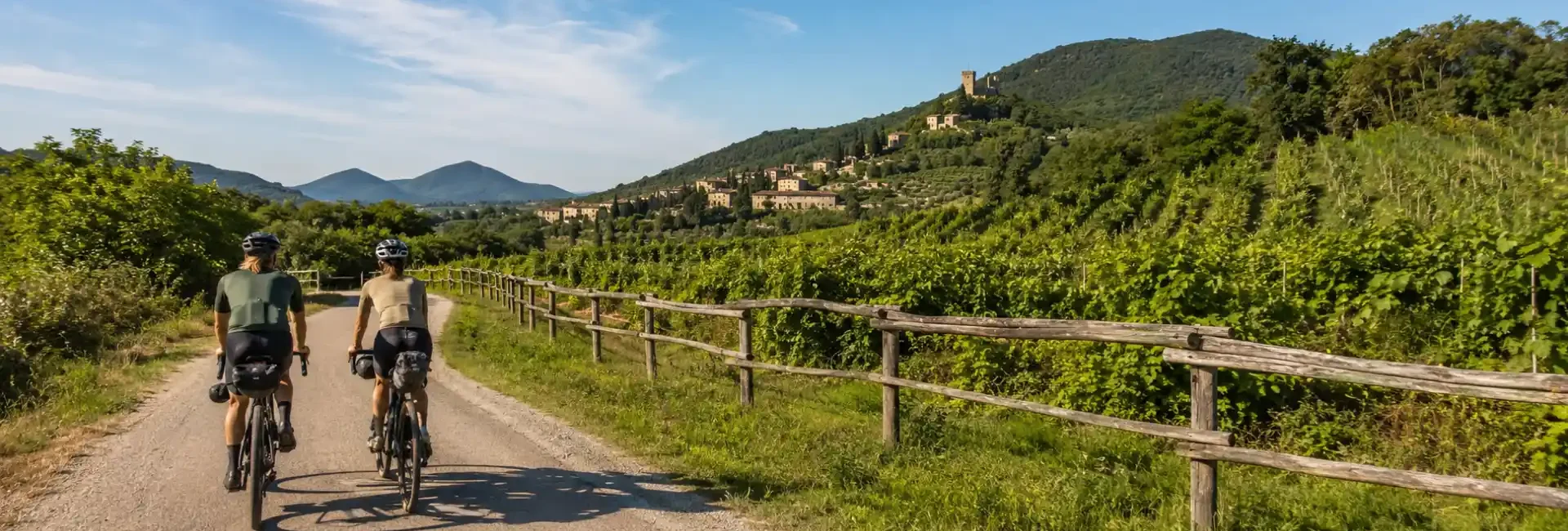
Arquà by Bike from Padua: Canals, Hills and Poetry
Reaching Arquà by bike from Padua means gradually moving from the city to riverbanks, historic waterways and open countryside before tackling the first climbs of the Euganean Hills. Starting from Hotel Giotto, cyclists can follow the route through Prato della Valle, Bassanello and the Canale Battaglia, continue towards Battaglia Terme and complete the final section to the village where Francesco Petrarch spent the last years of his life.
How demanding is the route to Arquà?
The journey to Arquà is not entirely flat. The first section, from Padua to the spa area and Battaglia Terme, mainly follows cycle paths, riverbanks and quiet secondary roads with limited elevation gain. The route becomes more challenging during the final detour towards the village, where the gradients are noticeably steeper.
The actual distance depends on the chosen route, the access point to the Euganean Hills and the return option. Including the outward journey, the visit and the ride back to Padua, cyclists should prepare for a full day. Those who do not want to cycle in both directions can use the train to shorten part of the journey.
A gravel bike, trekking bike or e-bike is generally the most versatile choice. A road bike can be used by selecting a fully paved route, while a city bike is suitable only for cyclists accustomed to medium or long distances and the final climb.
Starting from Hotel Giotto
From Hotel Giotto, the route heads towards Prato della Valle, with particular care required at urban crossings and around the tram tracks. Cyclists then continue towards Bassanello, where one of the main cycling routes leading south out of Padua begins.
Before setting off for Arquà, it is advisable to download the route to a smartphone or cycling computer and keep an offline copy available. Automatic navigation systems may suggest busy roads or alternatives that are unsuitable for the type of bicycle being used.
Leaving the city requires additional attention at junctions and where cycle paths change sides of the road. Maintaining a moderate speed is recommended, as cyclists should not rely exclusively on cycle-route signs.
From Bassanello to Montegrotto along the Canale Battaglia
The cycling connection between Bassanello and Montegrotto Terme is an easy route of approximately 10.9 kilometres. It follows the Canale Battaglia and allows cyclists to leave the urban area gradually while travelling towards the Euganean Hills.
The canal was excavated between the twelfth and thirteenth centuries to improve water management and connect Padua with Monselice, Este and the Euganean area. For centuries, it was travelled by large cargo boats known as burci, which transported goods, agricultural products and trachyte extracted from the hills.
Along the route stands Villa Molin, designed by Vincenzo Scamozzi at the end of the sixteenth century. Its strategic position near the meeting point of several waterways reflects the historical relationship between Venetian villas, navigation and the countryside surrounding Padua.
Montegrotto Terme and the spa landscape
As cyclists approach Montegrotto Terme, the profiles of the Euganean Hills become increasingly visible. The area is known for its thermal waters and for archaeological evidence connected with the ancient use of the natural springs.
Anyone wishing to shorten the journey to Arquà can travel to Montegrotto by train and begin cycling from there. Terme Euganee-Abano-Montegrotto station is served by regional trains, although travellers must check that the selected service accepts fully assembled bicycles.
Montegrotto can also be used as the final point of the return journey. This option allows cyclists to complete the most interesting part of the route without having to ride all the way back to Padua.
Battaglia Terme, canals and river navigation
Continuing south, the route reaches Battaglia Terme, one of the main eastern gateways to the Euganean Hills. The town is crossed by canals, bridges and hydraulic structures that reflect its long history of river navigation.
The Museum of River Navigation preserves accounts and objects connected with boatmen, traditional cargo vessels and the commercial activities that once developed along the waterways. Opening times should be checked before departure, as access arrangements can change during the year.
Before continuing towards Arquà, it is useful to take a break, check the remaining water supply and assess personal fitness. From this point, the route gradually leaves the flat canal corridor and approaches the lower slopes of the hills.
The Catajo Castle along the route to Arquà
Close to Battaglia Terme stands the Catajo Castle, built from the sixteenth century onwards by the Obizzi family. The complex combines the appearance of an aristocratic residence with that of a fortress and overlooks the surrounding landscape from the foot of the hill.
Including a visit during the same cycling day is possible, but the time needed for admission, the interior tour and the climb from the bicycle parking area must be considered. Booking in advance is advisable on busy opening days.
Cyclists who prefer to spend more time in Arquà can view the castle from outside and plan a dedicated visit during another day in the Euganean Hills.
The detour towards the village
The Euganean Hills Cycle Ring does not pass directly through the historic centre of Arquà. To reach the village, cyclists must leave the main route and follow a detour into the interior of the park.
The final section has steeper gradients than the route across the plain. The level of difficulty depends on the selected road, the weight being carried and the cyclist’s fitness. With heavily loaded touring bags, it may be necessary to use very low gears or walk the bicycle along the steepest sections.
The hottest summer hours should be avoided. The climb and exposure to the sun can require considerably more water than the flat section of the journey.
Arriving in Arquà Petrarca
Arquà lies between Monte Piccolo and Monte Ventolone in the southern part of the Euganean Hills. The village is built on several levels, with narrow streets, uneven paving and views over vineyards and olive groves.
After reaching the centre, cyclists should find an authorised place to leave their bicycle and continue on foot. Riding through the steepest or most crowded streets can be impractical and may inconvenience pedestrians.
The bicycle should be secured with a strong lock, attaching the frame to a stable structure. Removable batteries, displays, lights and bags containing valuable items should be taken along during the visit.
Petrarch’s House
Petrarch’s House is the best-known landmark in Arquà. The poet spent the final years of his life here after receiving the estate from Francesco il Vecchio da Carrara, Lord of Padua.
The building preserves rooms, frescoes, furnishings and historical objects connected with Petrarch’s life. One of its most curious features is the niche traditionally associated with Petrarch’s cat, commemorated by a Latin inscription.
Opening hours, admission tickets and visitor arrangements should always be checked before departure. Arriving late in the afternoon without verifying the schedule may prevent access, especially on days with reduced opening hours.
Petrarch’s Tomb and the Church of Santa Maria Assunta
In the lower part of Arquà, in front of the Church of Santa Maria Assunta, stands the marble tomb of Francesco Petrarch. Built a few years after the poet’s death, the monument recalls the shape of an ancient Roman sarcophagus.
The church has a long history and occupies one of the village’s most recognisable locations. The square is an ideal place for a short break before exploring the upper streets or beginning the return journey.
The fountain and Petrarch’s literary legacy
Another place connected with Petrarch is the historic fountain located along the village street. Tradition links the spring to the poet, although the visible structure has been modified and restored several times over the centuries.
Exploring Arquà by bicycle allows visitors to appreciate the close relationship between literature and landscape. Vineyards, olive groves, woodland and rolling hills help explain why Petrarch chose this peaceful village for the final chapter of his life.
Where to stop for local food
The village’s signature product is the jujube fruit. It is used to prepare jams, desserts, liqueurs and the famous brodo di giuggiole, a traditional sweet liqueur. Harvest season generally takes place between late summer and autumn.
During a cycling trip, it is advisable to choose a light meal and allow enough time for digestion before riding downhill. Cyclists returning to the saddle should avoid drinking wine or spirits.
At weekends, restaurants and cafés in Arquà can become very busy. Larger groups should reserve in advance or carry enough water and food so they are not entirely dependent on local facilities.
Three options for the return journey
Return entirely by bicycle
The most complete option is to follow the same route back through Battaglia Terme, Montegrotto, Bassanello and Padua. Before choosing this solution, consider the energy already used on the climb, the remaining daylight and any possible headwind.
Reach Monselice railway station
From Arquà, cyclists can descend towards the plain and continue to Monselice using a route suitable for their bicycle. Regional trains to Padua are available from the station, provided that the selected service accepts bicycles and has available space.
Return via Terme Euganee station
Another option is to ride back through Battaglia Terme and Montegrotto before reaching Terme Euganee-Abano-Montegrotto station. This keeps most of the return journey on the same pleasant cycling corridor used at the start of the day.
Regional trains allow the transport of fully assembled bicycles on authorised services, subject to availability and the appropriate bicycle ticket. Before travelling, always check the selected service and bicycle policy.
Starting directly by train from Padua
Cyclists who prefer to avoid the entire urban section can board a regional train in Padua and start their ride from Terme Euganee or Monselice. Both stations provide convenient access to Arquà while reducing the overall distance.
Hotel Giotto is connected to Padua railway station by the city’s cycling network. While riding through the centre, pay particular attention to intersections, pedestrian areas and tram tracks, crossing them at a safe angle.
Folded bicycles can normally be transported free of charge within the permitted dimensions. Standard bicycles require a service that allows bicycle transport and the appropriate supplement where applicable.
Best time to ride to Arquà
Spring and autumn are generally the most comfortable seasons for cycling to Arquà. Cooler temperatures make the final climb more enjoyable and reduce the effects of prolonged sun exposure.
During summer, an early departure is recommended together with at least two water bottles. Long stretches through the countryside can be exposed to direct sunlight, and water refill points should never be taken for granted.
After heavy rainfall, cyclists should check the road surface, possible debris and temporary closures. During winter, shorter daylight hours require reliable bicycle lights and careful timing for the return journey.
Recommended equipment
- Two water bottles and energy snacks.
- Spare inner tube or tubeless repair kit.
- Pump, tyre levers and multitool.
- Front and rear bicycle lights.
- Offline GPX route.
- Power bank for smartphone or GPS.
- Strong bicycle lock.
- Windproof or waterproof jacket.
Before leaving for Arquà, check tyre pressure, brakes, drivetrain and e-bike battery level. Make sure enough battery capacity remains for the final climb, possible detours and the return journey to Padua or the railway station.
Staying at Hotel Giotto
Hotel Giotto provides a dedicated bicycle storage area. Guests are encouraged to communicate the number and type of bicycles before arrival, especially when travelling with e-bikes, tandems, trailers or larger groups.
Rooms include a private bathroom, air conditioning, Wi-Fi, television and minibar. Breakfast offers both sweet and savoury options, providing an excellent start before a full day in the saddle.
Practical information on reaching the hotel is available on the How to reach Hotel Giotto page.
Book your cycling stay
From Hotel Giotto, you can organise a memorable day trip to Arquà, whether cycling the full route or combining the journey with regional trains. Before booking, let us know how many bicycles you will bring so we can confirm storage availability.
Frequently Asked Questions
How difficult is the ride from Padua to Arquà?
The first section is mostly flat, while the final climb to the village is more demanding. The overall difficulty depends on fitness level and the chosen route.
Which bicycle is best for this route?
Gravel bikes, trekking bikes and e-bikes are the most versatile choices. Road bikes are suitable on paved routes.
Can I return to Padua by train with my bicycle?
Yes. Regional trains from Monselice or Terme Euganee can be used if they allow bicycle transport and have available space.
Where should I leave my bicycle in Arquà?
Use authorised bicycle parking areas and secure the frame with a strong lock before exploring the village on foot.
What should I visit in Arquà?
The main attractions include Petrarch’s House, the poet’s tomb, the Church of Santa Maria Assunta and the historic streets of the village.
Does Hotel Giotto offer bicycle storage?
Yes. Hotel Giotto has a dedicated bicycle storage area. Guests are encouraged to request confirmation before arrival.
You may also be interested in: Hotel with Bike Storage Near the City Centre, Hotel with Secure Bicycle Storage, Bike Security in Padua: Where to Leave Your Bicycle During Your Stay, Cycling Routes from Padua: Rivers, Historic Villages and the Euganean Hills, Euganei by Bike: Cycling Through Villages, Spa Towns and Volcanic Landscapes, Ostiglia Cycle Route from Padua and Weekend by Bike in Padua: A Two or Three-Day Cycling Itinerary.